All posts by admin

How Does NDIS 24/7 In-Home Support Deliver Total Night-Time Safety for Participants?

Night-time can be scary for people needing disability support. They worry about emergencies, falls, and sudden health issues. An NDIS registered provider in Melbourne can offer round-the-clock assistance as per participant needs. This support transforms nights into secure, peaceful times for them as well as their families.

Understanding 24/7 In-Home Disability Support

24-hour disability support in Melbourne means trained workers are available every single moment. These professionals understand night-time safety protocols and emergency response procedures. They provide comprehensive assistance with personal care, medication management, and safety monitoring.

Major Benefits of Round-the-Clock Support

  • Immediate emergency response when needed most
  • Continuous monitoring during sleep hours
  • Quick assistance for bathroom visits and mobility support
  • Peace of mind for families and caregivers

How Night-Time Safety Is Delivered

Trained Professional Care

Support workers receive specialised training in disability support services. They understand individual needs and risks specific to participants. Each worker follows personalised care plans developed with healthcare professionals.

Technology and Monitoring

NDIS in-home 24/7 support in Melbourne integrates modern safety systems. Alert buttons, fall detection devices, and communication systems stay active. These assistive technology solutions help workers respond instantly to any issue.

Medication and Health Management

Workers ensure medications are taken correctly at night. They monitor health conditions and watch for warning signs. This prevents serious complications during vulnerable sleeping hours.

Creating a Safe Night-Time Environment

Physical Safety Features

Homes are modified for maximum safety and accessibility. Grab bars, adequate lighting, and clear pathways reduce fall risks. 24/7 disability support in Melbourne includes regular safety assessments and updates.

Emotional Support During Night Hours

Many participants feel anxious at night. Support workers provide reassurance and companionship. This reduces anxiety and helps people sleep better.

The Participant Experience

People using NDIS-funded in-home support report improved confidence. They sleep better knowing help is always available. Family members feel less worried about emergencies. This support allows participants greater independence during daytime hours, too.

Enhanced Quality of Life

  • Participants maintain dignity and privacy
  • Families experience reduced stress levels
  • Individuals enjoy greater freedom and control
  • Safety concerns no longer limit daily activities

Support Extends Beyond Night Hours

While focused on nighttime safety, these services support overall wellness. Holistic disability care means addressing physical, emotional, and social needs. Workers help participants achieve personal goals while maintaining safety.

Accessing This Vital Support

The process starts with recognising your needs. Contact your nearest support coordination service to discuss options. Healthcare professionals can help identify if 24/7 support suits your situation. Planning ensures services match your specific requirements perfectly.

Conclusion

Safety at night should never be a luxury. NDIS in-home 24/7 disability support in Melbourne makes secure nights possible for everyone. Participants deserve rest without fear or worry. If you need expert, compassionate round-the-clock disability support, reach out today.

Contact Inclusive Futures Network – NDIS Programs:

Our experienced team is ready to discuss your needs and create a safety plan tailored to you.

Frequently Asked Questions

  1. What exactly is included in 24/7 in-home support?

Support covers personal care, medication management, emergency response, mobility assistance, and companionship throughout the day and night.

  1. How quickly do support workers respond to emergencies?

Trained workers on-site or on-call respond immediately to any emergency or health concern requiring urgent attention.

  1. Is 24/7 support available for all NDIS participants?

Support availability depends on individual needs assessment and NDIS plan approval. Contact your support coordinator to explore eligibility.

  1. How are support workers trained for night-time care?

Workers receive specialised training in emergency response, health monitoring, and disability-specific care protocols before starting.

  1. Can participants choose their support workers?

Many services allow preferences in worker selection. Discuss this with your provider to find the best match for your needs.

  1. What happens if a participant has unusual sleeping patterns?

Support is tailored to individual schedules. Whether you sleep during the day or at night, workers adjust their presence accordingly.

  1. How does nighttime support help with anxiety and stress?

Having trained professionals available reduces worry about emergencies. This creates a calming environment, promoting better sleep quality.

  1. Is night-time support covered by NDIS plans?

Yes, if approved in your NDIS plan. Speak with your planner about including 24/7 support in your funding allocation.

  1. How do support workers maintain privacy during nighttime care?

Professionals respect dignity and privacy. They follow strict protocols, ensuring personal care is delivered with sensitivity and respect.

  1. What safety modifications are typically made to homes?

Common modifications include improved lighting, grab bars, accessible pathways, and alert systems. Safety plans address individual risks and needs.
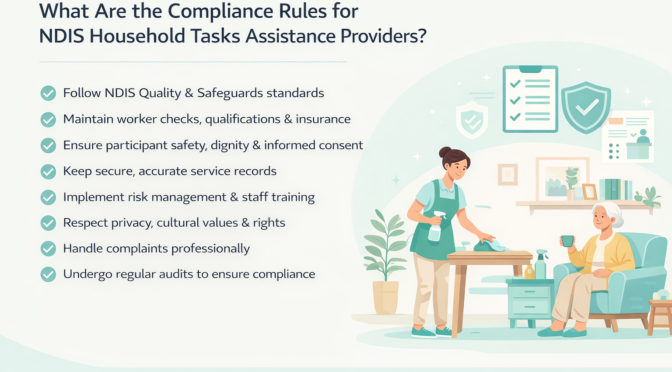

What Are the Compliance Rules for NDIS Household Tasks Assistance Providers?

Providing support services through the NDIS requires strict adherence to compliance rules. Household tasks assistance providers must understand regulations protecting participants. Quality standards ensure safe, dignified, and person-centred care delivery. This guide breaks down essential compliance requirements into simple, actionable information.

Understanding NDIS Compliance Fundamentals

NDIS service in Melbourne and across regions must follow comprehensive compliance frameworks. Providers must meet quality and safety standards established by the NDIS. Compliance protects vulnerable participants from harm. Non-compliance can result in serious consequences for providers.

The NDIS Quality and Safeguarding Commission oversees provider accountability. Providers must implement documentation systems to track all support delivered. Regular audits ensure ongoing compliance with regulations. Participants have rights that providers must respect and protect.

Key Compliance Requirements for Providers

Core Compliance Areas

  • Maintain appropriate qualifications and credentials for support workers.
  • Complete police checks and working with children checks regularly.
  • Obtain proper insurance coverage for all services delivered.
  • Keep detailed service records and participant information securely.
  • Ensure confidentiality and privacy of all participant data.

Quality and Safeguarding Standards

NDIS support services in Melbourne must prioritise participant safety above all else. Providers must implement risk management systems to identify potential hazards. Staff training on safeguarding practices is mandatory and ongoing. Participants should feel secure when receiving assistance with tasks.

Providers must have complaint-handling procedures in place for feedback. Issues must be addressed promptly and professionally. Documentation of complaints protects both participants and providers. Regular quality audits assess compliance with safety standards.

Participant Rights and Dignity

NDIS household task in Melbourne assistance must respect participant autonomy and choices. Providers must obtain informed consent before commencing any support. Participants control decisions about their own care and support. Workers must maintain professional boundaries at all times.

Support should be delivered with respect for individual cultural values and preferences. Participants have rights to dignity, privacy, and fair treatment. Discrimination or mistreatment is strictly prohibited under regulations. Workers must complete cultural competency training regularly.

Documentation and Record-Keeping

Household tasks assistance in Melbourne requires comprehensive record-keeping practices. Providers must document all services provided to participants. Records include time spent, tasks completed, and any concerns noted. Documentation must be accurate, timely, and stored securely.

Records are essential for quality assurance and regulatory audits. Participants have rights to access their own service records. Confidentiality laws govern how records are stored and shared. Digital systems must have appropriate data protection measures.

Conclusion

Compliance with NDIS regulations ensures quality service delivery and participant protection. Providers who understand and follow these rules build trust with participants. Regular training and updates keep staff informed of changing requirements.

Need expert NDIS support guidance? Inclusive Futures Network specialises in helping providers meet compliance standards. Our experienced team provides training, consultation, and ongoing support.

Contact us today for personalised compliance support and training solutions!

— — — — — — — — — — — — — — — — — — — — — — — — — — — — — — — — — — — — — — — — — — — — — — — — — — — — — — — — — — — —

Frequently Asked Questions

1. What qualifications must household tasks assistance workers have?

Workers should have relevant training in disability support and first aid. While specific certifications vary, providers must ensure workers are competent. Ongoing professional development is required for all staff members.

2. How often must providers undergo compliance audits?

The NDIS conducts audits based on risk assessments and complaints. Most providers undergo audits annually or biannually. Providers should maintain readiness for surprise audits at any time.

3. What happens if a provider fails a compliance audit?

Failed audits may result in corrective action plans or penalties. Serious breaches can lead to provider deregistration. Participants may seek alternative providers if concerns aren’t resolved.

4. Are background checks mandatory for all staff members?

Yes, police checks and working with children checks are mandatory. Checks must be renewed regularly according to regulations. Certain criminal records may prevent employment in support roles.

5. How should providers handle participant complaints?

Complaints must be documented and investigated promptly. Providers should respond within agreed timeframes. Records of complaints and resolutions must be maintained for quality assurance purposes.

6. What insurance coverage do household tasks providers need?

Providers must have adequate liability insurance and professional indemnity coverage. Insurance requirements depend on services provided. Participants should have proof of provider insurance before commencing support.

7. Can providers refuse to work with certain participants?

Providers cannot discriminate based on disability or characteristics. Refusal must be based on genuine safety concerns or service mismatch. Reasons for refusal must be documented and communicated respectfully.

8. How long must providers keep participant records?

Documentation standards require retention for minimum periods specified by NDIS. Generally, records should be kept for 7 years after service ends. Secure storage and data protection are mandatory throughout.

9. What should providers do if safeguarding concerns arise?

All safeguarding concerns must be reported immediately to the authorities. Providers should have clear reporting procedures in place. Failure to report suspected abuse is a serious compliance breach.

10. How can providers stay updated on compliance changes?

Subscribe to NDIS official communications and updates. Attend professional development training regularly. Connect with industry bodies that provide compliance guidance and resources.

How Can One Qualify for Support Coordination?

Navigating the NDIS can feel overwhelming, especially when determining eligibility for support coordination services. Understanding qualification criteria helps participants access the right level of assistance for their unique circumstances. This guide breaks down everything you need to know about qualifying for NDIS support coordination in Melbourne and the surrounding areas. Whether you’re new to the NDIS or reviewing your plan, knowing these requirements empowers better decision-making.

What Is Support Coordination Under the NDIS?

Support coordination helps NDIS participants understand and implement their plans effectively. Coordinators connect people with appropriate service providers and community supports. They build participants’ capacity to manage supports independently over time.

Key responsibilities include:

  • Strengthening participants’ skills in using their NDIS funding

  • Connecting individuals with mainstream and community services

  • Resolving service delivery issues and barriers

  • Monitoring plan implementation and progress

Who Can Access Support Coordination?

Not every NDIS participant automatically receives support coordination funding. The National Disability Insurance Agency (NDIS) assesses each person’s individual needs. Several factors determine eligibility for this valuable support.

Primary Qualification Criteria

Complexity of needs: Participants with multiple or complex support requirements often qualify. Those managing various health conditions or disabilities may need coordination assistance.

  1. Limited informal supports: People without strong family or community networks typically require additional help. This ensures they can access necessary services effectively.
  2. New to NDIS: First-time participants often receive support coordination funding initially. This helps them understand the scheme and connect with providers.
  3. Previous plan management challenges: Those who struggled with implementing earlier plans may qualify. Evidence of underutilisation or difficulty accessing services supports the request.

First-time participants often receive support coordination funding initially. This helps them understand the scheme and connect with providers.

Understanding the Three Coordination Levels

The NDIS offers different coordination levels based on individual circumstances.

Support Connection

This basic level suits participants who:

  • Need minimal assistance connecting with providers

  • Have straightforward goals and support arrangements

  • Possess some existing knowledge about available services

  • Require short-term guidance only

Support Coordination and Beyond

This mid-level option helps participants who:

  • Face moderate complexity in their situations

  • Need help building capacity and skills

  • Require assistance resolving service gaps

  • Want support navigating multiple provider relationships

Specialist Support Coordination

Reserved for highly complex situations involving:

  • Multiple service systems and government agencies

  • Significant behavioural support needs

  • Child protection or justice system involvement

  • Crises requiring intensive case management

Demonstrating Your Need for Coordination

Evidence Type

Examples

Medical documentation

Reports from specialists, therapists, or GPs

Previous plan reviews

Evidence of underutilised funding or service gaps

Functional assessments

Occupational therapy or capacity assessments

Support letters

Statements from current providers or carers

Clear documentation strengthens your coordination request significantly. Gather relevant evidence before your planning meeting.

How to Request Support Coordination?

Include your request during your NDIS planning conversation. Explain specific challenges you face in managing support independently. Provide examples of situations where coordination would help.

Your Local Area Coordinator or planner will assess:

  • Your current informal support networks

  • Complexity of your disability and goals

  • Previous experience managing NDIS plans

  • Specific barriers preventing you from accessing services

Maximising Your Coordination Funding

Once approved for support coordination in Doveton services or elsewhere, choose your coordinator wisely. Look for coordinators with:

  • Experience working with your disability type

  • Strong provider networks in your area

  • Excellent communication and advocacy skills

  • Positive participant reviews and outcomes

Regular communication with your coordinator ensures optimal plan utilisation. Share challenges promptly and work collaboratively towards your goals.

Reviewing and Maintaining Coordination Funding

Support coordination isn’t always permanent in NDIS plans. The goal involves building your capacity for independent plan management over time.

At plan reviews, demonstrate:

  • Progress towards independence in managing supports

  • Ongoing complexity requiring coordination assistance

  • New challenges or changing circumstances

  • Value gained from the current coordination support

Ready to Access the Support You Deserve?

Understanding qualification criteria empowers you to advocate effectively for necessary supports. Don’t navigate the NDIS alone when coordination assistance can make everything easier. Contact Inclusive Futures Network – NDIS Programs if you wish to access NDIS support coordination. Dial 0403 545 467 and let our expert providers handle your NDIS programs and plans for you!

Frequently Asked Questions

Can I change my support coordinator if I’m not satisfied? 

Yes, you control who provides your coordination services. Request a new coordinator anytime during your plan period.

How long does support coordination funding typically last?

Most participants receive 12-24 months initially. Extensions depend on ongoing needs and plan review outcomes.

Does support coordination reduce my funding for other supports? 

No, coordination comes from a separate capacity-building budget. It doesn’t affect funding for core or capital supports.

Can family members provide support coordination? 

Family cannot be paid coordinators for their relatives. NDIS requires independent, qualified professionals in this role.

What qualifications should support coordinators have? 

Coordinators need relevant disability sector experience and qualifications. Many hold degrees in social work, occupational therapy, or related fields.

Can NDIS Social Community Participation Improve Employment Opportunities?

Finding meaningful work can feel like an uphill battle for many people. However, community engagement activities might hold the key to unlocking new career pathways. When individuals connect with others and build valuable skills, doors begin to open. The NDIS recognises that social inclusion programs play a vital role in creating employment success.

Understanding the Connection Between Social Participation and Employment

Social community participation in Melbourne provides participants with essential workplace readiness skills. Through group activities, people learn communication, teamwork, and problem-solving abilities. These transferable skills are exactly what employers seek in potential candidates.

Community programs create safe spaces where participants can practise interacting with others. Building confidence through regular social contact helps reduce employment barriers. When people feel comfortable in group settings, job interviews become less intimidating.

How Community Activities Build Employment Skills

Participating in group activities naturally develops crucial soft skills that workplaces value:

  • Communication abilities through regular interaction with peers
  • Time management by attending scheduled activities consistently
  • Teamwork experience through collaborative projects and shared goals
  • Responsibility through taking on tasks within the group setting

Social community participation in Dandenong creates opportunities for participants to discover their strengths. Trying different activities helps people identify vocational interests they never knew existed. This exploration process is essential for finding suitable employment matches.

Networking Opportunities Through Social Programs

Building professional connections often happens naturally through community participation. Participants meet support workers, volunteers, and fellow community members regularly. These relationships can lead to job referrals and employment opportunities down the track.

Many employers value recommendations from trusted community organisations. When participants demonstrate reliability and enthusiasm in programs, coordinators can provide positive references. This social proof carries significant weight with potential employers.

Real-World Experience in Safe Environments

Social community participation in Springvale offers participants chances to gain pre-employment experience. Volunteering at community events provides practical skills without workplace pressure. These experiences look excellent on resumes and demonstrate initiative to employers.

Programs often include skill-building workshops tailored to employment preparation. Participants might learn resume writing, interview techniques, or workplace etiquette. This targeted support addresses specific employment challenges that individuals face.

Building Confidence and Self-Esteem

Regular participation in community activities significantly boosts self-confidence levels. When people succeed in social settings, they believe in their workplace potential. This positive mindset is crucial for job-seeking success and maintaining employment long-term.

Social community participation in Melbourne helps participants overcome social anxiety that might hinder employment. Gradual exposure to group situations builds comfort and reduces fear. Confident individuals perform better in interviews and workplace environments.

Creating Pathways to Supported Employment

Many community programs connect directly with supported employment providers and businesses. Social community participation in Dandenong can serve as a stepping stone. Participants transition from community activities to work experience placements more smoothly.

Some programs offer job coaching services alongside social activities. This integrated approach ensures participants receive comprehensive support throughout their employment journey. The combination of social skills and practical guidance creates strong foundations.

Long-Term Benefits Beyond Initial Employment

The connections made through social community participation in Springvale continue to benefit participants throughout their careers. Ongoing peer support networks provide encouragement during challenging work periods. These relationships become valuable professional resources for navigating workplace issues.

Participants also develop resilience skills through community involvement that translate to employment settings. Learning to handle social challenges prepares individuals for workplace conflicts and pressures. This emotional preparation is as important as technical skills.

Conclusion

Social community participation clearly creates pathways toward meaningful employment for NDIS participants. Through skill development, networking, and confidence building, these programs transform career prospects significantly. The connection between social engagement and workplace success cannot be overstated.

Ready to explore how community participation can enhance your employment journey? Contact Inclusive Futures Network – NDIS Programs today. We are a reputed disability services & support organisation committed to helping those with special needs diligently. Call us on 0403 545 467 or 0455 983 963 to discuss your goals. You can also email info@inclusivendisprograms.com.au or visit https://inclusivendisprograms.com.au/ for more information.

Frequently Asked Questions

  1. How does social participation directly lead to employment opportunities?

Social programs build essential workplace skills like communication, teamwork, and time management. Participants also create networks that often lead to job referrals and recommendations.

  1. What types of skills can I develop through community participation programs?

You can develop soft skills, including communication, problem-solving, teamwork, and reliability. Many programs also offer specific vocational training and workplace readiness workshops.

  1. How long does it take to see employment benefits from participation?

Results vary for each individual depending on their goals and circumstances. Some participants find opportunities within months, whilst others build skills gradually over longer periods.

  1. Can community participation help if I have no work experience?

These programs are designed to provide pre-employment experience in supportive environments. Volunteering and group activities demonstrate initiative and commitment to potential employers.

  1. Will participating in social programs guarantee me a job?

Whilst programs significantly improve employment prospects, they cannot guarantee positions. They provide skills, confidence, and connections that greatly increase your chances of success.

  1. How do I know which community activities will help my career goals?

NDIS support coordinators can help identify programs aligned with your vocational interests. Trying various activities helps you discover strengths and preferences naturally.

  1. Can I participate in programs whilst actively job searching?

Yes! Participation demonstrates to employers that you are proactive and committed to personal development. Many people continue programs even after securing employment.

  1. What if I feel anxious about joining group activities?

Programs are designed with varying support levels to accommodate different comfort zones. Start with smaller groups and gradually increase participation as confidence builds.

  1. Do employers actually value community participation on resumes?

Many employers appreciate seeing community involvement as it demonstrates social skills, reliability, and initiative. Volunteer experience is particularly valuable when formal work history is limited.

  1. How can I measure my progress in developing employment-ready skills?

Regular feedback from program coordinators helps track skill development. Setting personal goals and reviewing achievements with support workers provides clear progress indicators.

What Really Matters When Choosing an NDIS SIL Provider in 2026?

Finding the right Supported Independent Living (SIL) provider in 2026 isn’t just about ticking boxes; it’s about finding a place where life actually feels yours. With more choice than ever in supported independent living in Melbourne, families and participants are rightly asking deeper questions. Does this provider understand my goals? Will I feel safe, heard, and supported, not managed?

The best SIL providers today focus on lifestyle, not just logistics. Especially in NDIS SIL for young people with disabilities, independence looks different for everyone, and that difference should be respected from day one.

Are They Truly Person-Centred, or Just Saying They Are?

A quality SIL provider should build support around you, not squeeze you into a pre-set routine. This is especially important when exploring options with SIL providers in Hampton Park, where shared living is common.

Look for providers who:

  • Co-design daily routines with participants
  • Adapt support as goals change
  • Encourage real choice – meals, activities, housemates

This matters even more if you’re seeking a supported independent living provider for autism, where predictability, respect, and communication style make a huge difference to day-to-day wellbeing.

Do They Have Experience With Complex & Physical Support Needs?

Not all SIL providers are equipped for higher needs – and that’s okay, as long as they’re honest. If you or your loved one requires supported independent living with high physical support, experience is non-negotiable.

When speaking to SIL providers in Springvale, ask how they manage:

  • 24/7 active overnight support
  • Manual handling and mobility needs
  • Complex health routines

Confidence, calm staff, and clear systems are strong indicators you’re in capable hands.

Location Is Important – But Local Knowledge Is Priceless

Typing registered SIL providers near me into Google is a good start, but local understanding goes further. Providers who truly know supported independent living in Melbourne well understand community access, transport options, local employment pathways, and social opportunities.

This local insight is especially valuable for NDIS SIL for young people with disabilities, where connection, confidence, and community belonging matter just as much as care.

What Do Their Current Participants Actually Say?

Websites can promise everything, but lived experience tells the real story. Whether you’re exploring SIL providers in Hampton Park or broader options, ask to speak with current participants or families.

Listen for:

  • Consistency of support staff
  • How issues are resolved
  • Whether participants feel empowered

For those seeking a supported independent living provider for autism, emotional safety and respect often matter more than fancy facilities.

Ready to Take the Next Step With Confidence?
Let’s Build Independence Together.

Choosing the right SIL provider can shape the next chapter of life, and you don’t have to figure it out alone. Inclusive Futures Network – NDIS Programs supports individuals and families to find SIL that genuinely fits their goals, values, and future.

Call 0455 983 963 today and start a conversation that puts your independence first.

Frequently Asked Questions

  • Can I trial a SIL arrangement before committing long-term?

Yes, some providers offer short transition stays or flexible trial periods so you can assess compatibility, routines, and comfort before making a long-term decision.

  • How does SIL support evolve as I become more independent?

Good providers actively scale support down (or up) over time, ensuring your growth, confidence, and autonomy are always prioritised, especially in supported independent living in Melbourne, where participant-led models are becoming the norm.

  • Can SIL support personal goals like starting a small business or studying?

Absolutely. Progressive SIL providers align daily supports around employment, TAFE, university, or micro-business goals rather than limiting support to basic living tasks.

  • What happens if I don’t get along with my housemate?

Conflict happens, but the key is how it’s handled. Quality providers have mediation processes, clear house agreements, and alternative housing pathways if things don’t work out.

  • Is SIL suitable for people who value privacy and quiet living?

Yes. Many modern homes, including options within supported independent living in Melbourne, are designed for low-stimulation environments with private rooms and flexible social engagement.

  • Can my family still be involved once I move into SIL?

Definitely. The best SIL models actively encourage family participation, regular check-ins, and open communication – as much or as little as the participant wants.

  • How do providers support cultural or lifestyle preferences?

From food choices to religious practices and daily routines, strong SIL providers build support around identity, not convenience.

  • What makes a SIL provider “future-ready” for 2026 and beyond?

Think assistive technology, skill-building programs, community partnerships, and adaptable housing models – all increasingly visible in supported independent living in Melbourne.

  • Can SIL work for someone who has never lived away from home before?

Yes, with the right transition planning. Gradual onboarding, emotional support, and trust-building are key parts of successful first-time SIL experiences.

  • How do I know if a provider genuinely listens to participants?

Look for co-designed support plans, regular feedback sessions, and visible changes based on participant input – hallmarks of ethical providers in supported independent living in Melbourne.

Why Is NDIS Community Participation a Popular Choice for New Year’s Day?

New Year’s Day is all about fresh starts and great intentions. For many NDIS participants, it symbolises a fresh era. This spirit is well aligned with the activities chosen for community participation. It transforms promises of closer social ties into happy, instantaneous action.

NDIS community participation in Melbourne helps people participate in social and recreational activities that are group-based. It creates enduring friendships and encourages independence. Starting on January 1st establishes a strong, hopeful tone for the full year.

Building Social Connections From Day One

The new year can feel isolating after the holidays end. Structured community engagement counters this effectively. It immediately offers a friendly, planned activity. Participants interact with peers who share their interests. This establishes a reliable social network quickly. It tackles post-holiday loneliness head-on. Starting this habit on New Year’s Day is powerful. Joining a social community participation in Dandenong groups, for instance, provides a sense of belonging right now. It turns a regular day into a springboard for connection.

Turning Resolutions into Tangible Action

“Be more social” is an example of a vague objective that frequently fails. NDIS community participation support makes them concrete. It is a goal-oriented service with definite results. Participants may enrol in an art class or a community garden. Every exercise improves everyday living abilities in a practical environment. This practical approach ensures meaningful progress. It translates New Year’s hopes into measurable, weekly successes.

Community Participation Melbourne | NDIS Community Participation Melbourne

Improving Well-Being by Purposeful Involvement

Everyone’s main goal for the new year is to improve their well-being. NDIS social inclusion directly boosts mental and physical health. Hobbies and inclusive social activities boost happiness and lower stress levels. It encourages both personal and skill development. Participants acquire self-assurance in a nurturing setting. This fosters greater community inclusion naturally. Making this decision on January 1st puts health first. It’s a dedication to living a more contented life.

A Helpful Beginning to New Journeys

It can be intimidating to try new activities. Safe and pleasurable encounters are facilitated by knowledgeable and skilled providers. They personalise community participation support to unfamiliar surroundings and social situations. Attempting thrilling tasks without fear is encouraged by this support. It might entail looking into a Hampton Park Community Participation programme. This fosters bravery and self-reliance from the first day of the year.

Establishing Positive Routines Early

Early-established routines are simpler to stick to. It is solidified when weekly supported group activities are started on New Year’s Day. It becomes a beloved part of one’s weekly schedule. This consistency is vital for long-term social and personal development. It guarantees consistent community involvement throughout the new year. A vibrant, connected existence is built on this foundation. This beneficial cycle can be started by looking into community participation in Hampton Park possibilities.

Seek the Right Support!

Inclusive Futures Network — NDIS Programs is a registered NDIS provider in the industry, specialising in core support like social community participation in Dandenong and the nearby areas. If you lack the confidence to go out and engage in the community and build relations, our providers can help. Call us and book a free consultation today!

FAQs

Can I use Core funding for NDIS community participation in Melbourne?

If it fits with your plan’s stated objectives for community and social engagement.

What if I feel anxious about group activities?

Support staff offer incremental, one-on-one help to help you gain comfort and confidence at your own speed.

How do I find acceptable activities in my area?

Discuss your interests with your support coordinator. They can help identify registered providers and local groups that match your passions.

How to Use Personal Care Support to Build Independence in Daily Routines?

Living independently doesn’t mean doing everything alone. For many participants, the right support at the right time can be the key to confidence, choice, and control. With NDIS personal care in Melbourne, NDIS personal care in Noble Park, and NDIS personal care in Springvale, personal care becomes a stepping stone, not a limitation.

What Does Independence Really Look Like in Daily Life?

Independence is about being involved in your own routines, decisions, and goals. With NDIS personal care in Melbourne, NDIS personal care in Noble Park, and NDIS personal care in Springvale, participants receive tailored NDIS personal care services that encourage active participation rather than passive support.

This includes:

  • Building confidence through routine
  • Learning skills at your own pace
  • Feeling safe while trying new things

The focus is always on you — your comfort, your preferences, your rhythm.

How Can Personal Care Support Encourage Skill-Building?

Personal care isn’t about “doing for”; it’s about “doing with”. Through assistance with daily personal activities NDIS, support workers gently guide participants to take the lead where possible. This approach is central to NDIS personal care in Melbourne, NDIS personal care in Noble Park, and NDIS personal care in Springvale.

Support may include:

  • Step-by-step guidance rather than full assistance
  • Encouraging choice in clothing, routines, and timing
  • Turning everyday tasks into learning moments

Over time, these small wins build real independence.

NDIS Personal Care Providers Melbourne

Can Support with Personal Hygiene Boost Confidence?

Absolutely. Tasks like personal hygiene can deeply affect self-esteem. With help with showering and dressing NDIS funding, participants feel supported without feeling rushed or judged. Providers offering NDIS personal care in Melbourne, NDIS personal care in Noble Park, and NDIS personal care in Springvale understand how dignity and patience make all the difference.

Benefits include:

  • Feeling comfortable in social settings
  • Developing body awareness and routine
  • Starting and ending the day with confidence

When personal care feels respectful, independence naturally grows.

Why Is the Right Provider So Important?

Choosing a ‘disability personal care provider near me’ isn’t just about availability; it’s about connection. The best NDIS personal care services are delivered by people who listen, adapt, and genuinely care. That’s why participants across NDIS personal care in Melbourne, NDIS personal care in Noble Park, and NDIS personal care in Springvale value consistency and trust.

Look for providers who:

  • Respect participant choices
  • Adapt support as skills grow
  • Celebrate progress, big or small

How Can Families Support Independence Through Personal Care?

Families play a huge role too. By aligning goals with providers offering NDIS personal care in Melbourne, NDIS personal care in Noble Park, and NDIS personal care in Springvale, everyone works towards the same outcome — greater independence.

Helpful tips:

  • Encourage participation, not perfection
  • Be patient with progress
  • Celebrate independence in everyday routines

With the right personal care support, daily routines become empowering moments. Independence isn’t rushed; it’s built, one confident step at a time.

Gain Freedom Today!

Contact Inclusive Futures Network — NDIS Programs.

At Inclusive Futures Network — NDIS Programs, we specialise in helping participants live life their way. Contact us today at 0455 983 963 for the right NDIS personal care services, and let our team help you thrive in your daily routines!

Frequently Asked Questions

1 What makes your personal care approach feel more empowering than traditional support?

We focus on building confidence, not dependence. Our support workers encourage participation, choice, and progress at a pace that feels comfortable, so everyday routines become moments of achievement.

2 How do you support independence without overwhelming participants?

We break routines into simple, achievable steps and gently increase involvement over time. This creates a calm, pressure-free environment where confidence grows naturally.

3 Can personal care support be adapted as someone becomes more independent?

Absolutely. Our support evolves with you. As skills improve, we adjust our approach to ensure support remains empowering rather than restrictive.

4 How do your support workers build trust so quickly?

Consistency, respect, and genuine care are at the heart of what we do. We take time to understand preferences, routines, and comfort levels, which helps participants feel safe and understood.

5 Is your service suitable for participants who value privacy and dignity?

Yes. We place a strong emphasis on discretion and respect, ensuring every interaction feels comfortable, dignified, and aligned with personal boundaries.

6 How do you help participants feel confident starting their day?

By creating predictable, positive routines that reduce stress and build self-belief. A supported, calm start often sets the tone for a more confident day ahead.

7 What sets your team apart from standard care providers?

We genuinely celebrate progress, no matter how small. Our team is invested in long-term outcomes, not quick fixes, and that makes our support feel personal and uplifting.

8 Do you support emotional confidence alongside daily routines?

Yes. Emotional reassurance is woven into every interaction, helping participants feel valued, capable, and supported beyond just practical tasks.

9 How do you ensure families feel confident in your support?

We maintain open communication and share progress regularly, giving families peace of mind and confidence that their loved ones are supported with care and intention.

10 Why do participants often stay with your service long-term?

Because they feel heard, respected, and empowered. Our personalised approach creates meaningful relationships that grow alongside each participant’s journey.

NDIS SIL Policy Changes 2026: What Participants Should Prepare For

The NDIS landscape is evolving, and the upcoming 2026 Supported Independent Living (SIL) policy changes are set to reshape how participants experience independence, choice, and day-to-day support. Whether you’re currently receiving SIL supports or considering them soon, now’s the perfect time to understand what’s coming and how to prepare confidently.

Most participants rely on trusted supports like SIL providers in Melbourne, so being ahead of the curve helps you keep your journey smooth and stress-free.

Most participants rely on trusted supports like SIL providers in Melbourne, so being ahead of the curve helps you keep your journey smooth and stress-free.

What’s Changing in SIL From 2026?

The NDIS will introduce several participant-centred reforms aimed at improving flexibility, transparency, and quality of support. Early insights show a shift towards:

  • More personalised funding models that focus on individual abilities and long-term goals
  • Greater clarity in rostering and support hour allocation to ensure fairness
  • Enhanced quality standards to raise accountability among service providers
  • Stronger emphasis on evidence-based support planning

With participants often relying on familiar supports such as SIL providers in Oakleigh, these changes are expected to create a more empowering experience – one where choice and control genuinely sit with you.

How These Changes May Affect Your SIL Journey

The SIL framework is moving toward a more consistent, participant-friendly structure. Here’s what you may notice:

  • More Transparent Funding

You’ll likely see detailed breakdowns of how your SIL funding is allocated—especially useful if you want to compare offerings or explore long-tail support options such as “how to transition smoothly between SIL houses” or “steps to personalise SIL support plans.”

  • Clearer Support Worker Responsibilities

Expect more defined roles for support workers, giving you clearer expectations around daily routines, community participation, and individualised skill-building.

  • Stronger Collaboration in Support Planning

You may be more involved in the planning stage, with providers, especially trusted ones like SIL providers in Clayton, offering deeper conversations around your preferences, cultural needs, and short- and long-term goals.

You may be more involved in the planning stage, with providers, especially trusted ones like SIL providers in Clayton, offering deeper conversations around your preferences, cultural needs, and short- and long-term goals.

How Participants Can Prepare for the 2026 SIL Updates

A little preparation now can help you navigate the transition with confidence.

  • Review Your Current SIL Goals

Think about what’s working for you and what isn’t. Do you want more social participation? More independence at home? Write these down to discuss with your support coordinator.

  • Start Conversations Early

Engage in open chats with your existing provider. Ask them how they’re preparing for the new framework and what it means for your current supports.

  • Explore Your Options

Now is a great time to look at long-tail support queries like:

    1. “What to ask before changing SIL houses”
    2. “How SIL participants can build daily living skills ahead of reviews”
    3. “What personal documentation to prepare for SIL plan reassessments”
  • Keep Documentation Ready

Collect medical reports, daily routines, incident notes, and any relevant assessments. These will be helpful when the new planning processes roll out.

Final Thoughts

The 2026 SIL policy changes are designed to make your experience with SIL providers in Melbourne more personalised, transparent, and empowering. By starting early conversations, reviewing your goals, and staying informed, you can embrace the shift with confidence.

The future of SIL is bright, and these changes are here to help you lead a more independent, fulfilling life on your own terms.

Learn More From Inclusive Futures Network – NDIS Programs!

Our team at Inclusive Futures Network – NDIS Programs can help you better understand every upcoming change in NDIS supported independent living (SIL) and ensure you get the most out of it in 2026. Contact us today at 0455 983 963 to schedule a consultation!

Frequently Asked Questions

  1. Can I move into a new SIL home even if I’m unsure about my long-term goals?

Absolutely. Many participants start their journey while still figuring things out. We support you with flexible planning, gentle guidance, and regular check-ins so you can explore options without pressure.

  1. Do you help participants personalise their living spaces to feel more like home?

Yes! We encourage you to personalise your room and shared spaces. From layout suggestions to accessibility ideas, our team loves helping you create a space that feels comforting and truly yours.

  1. What if I want more independence than support? Can you adjust the balance?

Definitely. We tailor support levels around your abilities and preferences. As your independence grows, we adjust your plan to match your confidence and skill development.

  1. How do you support participants who feel anxious about living with others?

We take a gentle, people-first approach. You’ll receive emotional support, gradual introductions, compatibility-focused placements, and continued reassurance to help you settle in comfortably.

  1. Can you help me transition from another provider with zero stress?

Yes. We manage the entire transition – from paperwork to coordination – so you can move smoothly without feeling overwhelmed.

  1. What if my cultural background or routines are different from others in the home?

We deeply respect cultural needs and help you maintain your personal routines. We also create a supportive environment where housemates appreciate and celebrate individual differences.

  1. Do you provide support for participants who want to learn home-management skills?

We love helping with this! Cooking, cleaning, budgeting, time-management – we work with you step-by-step so these skills become part of your everyday life.

  1. What happens if my needs suddenly change, even late at night or early morning?

You’ll never be left alone during urgent changes. Our team responds promptly and adjusts support to prioritise your comfort and safety.

  1. Can I bring my own support team or mix supports from different organisations?

Yes. We encourage collaborative support. If you have preferred allied health professionals, mentors, or recovery coaches, we happily work alongside them for your benefit.

  1. If I want more community engagement, do you help me find activities that match my interests?

Absolutely. Whether you enjoy sports, arts, social groups, volunteering, or simply exploring the neighbourhood, we help you discover activities that make your days more enjoyable and meaningful.

How is Person-Centred Care Redefining NDIS Personal Care in 2025?


Imagine waking up knowing that your daily support reflects your preferences, your rhythms, your goals. In 2025, the world of National Disability Insurance Scheme (NDIS) personal care is shifting: moving from one-size-fits-all to an approach where you steer the journey. With the emphasis on choice, control, and independence, the role of an NDIS personal care provider in Melbourne becomes a partner walking alongside you, not ahead of you.

What Does “ NDIS Person-Centred” Really Mean?

NDIS person-centred care revolves around placing you at the center of every decision. It gives you control over the when, where, and how of the support you receive. According to a recent industry review, this approach empowers participants to take ownership of their plans, ensuring the support they get aligns with their goals and aspirations.

This means more than just routine assistance; it’s about shaping your life with meaningful support.

Why Is This Shift Happening Now?

Three key factors are driving the transformation:

  • Participants are increasingly seeking greater control, and the trend of “more control in the hands of participants” is gaining momentum.
  • Technology is playing a key role in enabling flexible support, with apps, portals, and smart devices that allow support to be tailored to individual needs, rather than requiring participants to adjust to the system.
  • At the same time, funders and regulators are shifting their focus towards outcomes, not just the delivery of services. NDIS providers are now expected to demonstrate meaningful impact, rather than simply fulfilling the basic requirements.

One declarative statistic: Many analysts reveal that the number of participants opting for self-managed plans has increased significantly in the last 12 months.

How NDIS Person-Centred Care Enhances Participants’ Daily Life?

If you or your loved one is an eligible NDIS participant, then here’s how this model transforms everyday support into something empowering:

  • You decide who supports you, when, where, and how your routines, your preferences.
  • Flexibility is built in: if your goals change, the support can adapt.
  • Skill-building is part of the support for gaining or enhancing independence in tasks you value.
  • Technology integration: Wearable devices, digital communication tools, and smart home features are becoming key enablers of independence, helping individuals manage their daily lives with greater ease and autonomy.
  • Connection and community: Support is designed to fit into your life, your social world, and your ambitions.

Why Choose A Professional NDIS Personal Care Provider?

The leading providers of NDIS personal care in Keysborough are the ones on whom you can rely for empowering companions in your journey. Here’s what makes them different:

  • They focus on your voice first; you lead; they follow.
  • The experts of a renowned disability services & support organisation in Melbourne, Keysborough, and Oakleigh are always available 24/7 to offer exceptional service.
  • They bring local expertise: offering NDIS personal care in Melbourne, Keysborough, and Oakleigh.
  • Their staff are trained in empathy, communication, tech-enabled support, and goal-alignment, helping you gain more than just assistance: we help you thrive.

Frequently Asked Questions (FAQs)

Q1. What exactly is person-centred care under the NDIS?

It’s a model where you are central, choosing how your support aligns with your life, your goals, and your preferences.

Q2. Can I choose the times and days my support worker visits?

Yes. Flexibility is one of the hallmarks of this approach. You pick what suits you.

Q3. How do I know I’m working with a quality NDIS personal care provider in Melbourne?

Look for providers who emphasise your voice, offer transparent communication, show outcomes, and serve your local area.

Q4. Does this approach apply to NDIS personal care in Keysborough and Oakleigh?

Absolutely. In those suburbs, you can expect the same participant-led, flexible model, with staff familiar with local needs.

Q5. What makes a good plan when choosing an NDIS personal care provider in Keysborough?

A strong plan reflects your goals, tracks progress, and is adaptable. A good NDIS personal care provider in Keysborough helps you shape it, not simply follow it.

Q6. How does technology support this model?

Digital tools empower you to book support services, track your budget, communicate efficiently, and, in some cases, monitor your progress remotely.

Q7. If I live in Melbourne and need an NDIS personal care provider, how do I begin?

Start by reaching out and having a conversation: your goals, your routines, your preferences. Good providers will listen first and, based on your needs, will offer the best NDIS personal care in Melbourne.

Q8. For NDIS personal care in Oakleigh, is there any difference compared to other suburbs?

The core philosophy is the same, but local providers may offer tailored knowledge about Oakleigh’s community, transit, and resources.

Q9. What role does a disability services & support organisation play?

Such organisations offer the infrastructure, local staff, governance, and standards required to deliver high-quality support.

Q10. How can I be sure that this approach will actually promote independence rather than just providing a service?

When evaluating outcomes, it’s important to ask: how many participants gained new skills, made empowered choices, and increased their independence? The best providers measure success by these meaningful impacts, not just by services delivered.

Ready to Take the Next Step?

If you’re in Melbourne, Keysborough, or Oakleigh and ready to embrace a support model centred on you, your choices, and your freedom, then the experts of Inclusive Futures Network – NDIS Programs are always ready to listen. Let’s co-create your support journey. Reach out today to schedule a chat, no obligations, just an opportunity. Your independence is our mission.

Contact us now and discover how NDIS person-centred care can redefine your support experience.

How Can You Improve Goal Achievement with Support Coordination?

Support planning can help you reach your goals more easily, which can change how you use the National Disability Insurance Scheme. Support planning helps people connect with services, keep track of their goals, and become more independent. For better results, you need to know how it strengthens your planning and execution approach.

This blog talks about useful ways to help NDIS support coordination in Melbourne work better for you.

What Does Support Coordination Mean?

Support coordination in Dandenong helps people with the NDIS understand and use their plan well. It puts you in touch with the right mobility support services so that your goals are attainable. This service also helps you learn skills that will help you become more independent and involved in your community.

NDIS Support Coordination session with participant in a wheelchair

How Support Coordination Helps You Reach Your Goals?

  • Makes Your Goals Clear: Support managers help you set clear, attainable goals that are in line with your needs and goals. Clear goals help you find your way and keep you going.
  • Makes It Easier To Get To Services: It can be hard to find NDIS companies. Coordinators find the best tools to meet the goals of your plan, which saves you time and stress.
  • Helps You Do More: Support planning helps people learn the skills they need to handle problems on their own. This method helps people feel good about the choices they make.
  • Checking on Progress: Review meetings on a regular basis will help your goals stay relevant. Coordinators change plans when things change or when people’s needs change.

How to Get the Most Out of Support Coordination?

  • Stay Engaged: Talk to your coordinator often about any changes in your wants or preferences. In this way, your plan stays open.
  • Keep Track Of Your Progress: To keep track of goals and obstacles, keep a simple journal or digital record.
  • Ask for Feedback: To make your experience better, ask support workers and coordinators for comments all the time.
  • Use Resources In Your Community: Add local social, educational, or leisure programmes to your plan to make it better.

Why Should You Pick a Qualified Coordinator?

A good coordinator knows a lot about how the NDIS works and how to connect people in the community. The more experience they have, the easier it will be to reach their goals.

If you’re looking into NDIS support coordination in Noble Park, their coordinators will help you find options that fit your needs. Support Coordination and other services offer focused support to people who want it, helping participants handle complicated plans.

Inclusive Futures Network— NDIS Programs is the name you trust when it comes to expert and qualified NDIS support coordination in Melbourne. We specialise in personalising tasks and support services for you, so you feel empowered. Our support coordination services help you navigate your NDIS plans and maximise their benefits. Call 0403 545 467 for a free consultation.

FAQs

How Often Should I Catch Up With My Support Person?

Ideally, every few months or when there are big changes to the plan.

Can Coordinating Support Help With Choices About Funding?

Coordinators help you, but they don’t decide how to spend your money.

Do NDIS Users Have To Use Support Coordination?

No, it’s not required, but it will help your plan work better if you do.