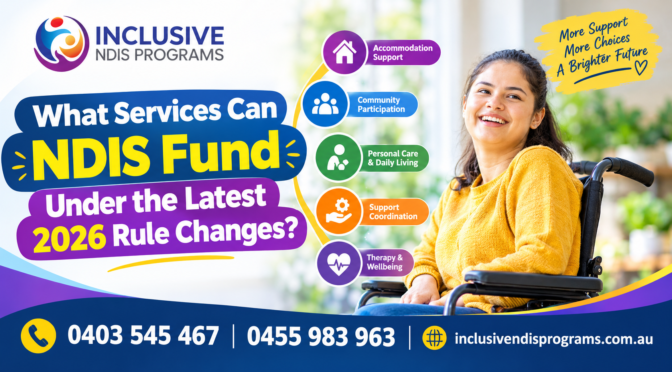
What Services Can NDIS Fund Under the Latest 2026 Rule Changes?

The NDIS has just undergone its biggest transformation since it began. New laws took effect from August 2026, changing how plans work. These changes affect what services get funding and how they’re organised. Your disability funding options are now structured differently than before.

Three Main Funding Categories Explained

The NDIS divides all funding into three clear types. Each serves a different purpose for participants. Understanding these support categories helps you access the right services. Let’s explore what each one covers.

Core Supports: Your Daily Living Budget

Core Supports fund everyday assistance and essential community participation. This is your most flexible funding type. You can shift money between different areas within Core. Under this category, NDIS disability support in Melbourne includes personal care, household tasks, and transport services.

What Core Supports Cover:

  • Personal care and hygiene assistance
  • Household cleaning and meal preparation
  • Transport to appointments and activities
  • Disability-related consumables (continence products, mobility aids)
  • Social and community participation activities

Core represents 60–70% of most participant plans. This core funding remains flexible unless stated otherwise. You cannot move Core money to other categories.

Capacity Building Supports: Skills and Independence

Capacity Building funds long-term skill development and independence building. These supports help you grow over time. Therapy services fall under this category. Under this category, NDIS care services in Melbourne include speech therapy, occupational therapy, and physiotherapy.

What Capacity Building Supports Include:

  • Speech and language therapy services
  • Occupational and physiotherapy support
  • Support coordination and plan management
  • Behaviour support and social skills training
  • Specialist exercise physiology and dietetics

This funding is more structured than Core. Each support must align with your personal development goals. Funding cannot move between Capacity Building categories.

Capital Supports: Equipment and Housing

Capital Supports fund larger, one-off items you need. These are permanent purchases, not ongoing services. A reliable NDIS support provider in Melbourne can help you access these items. This funding covers assistive technology and home safety.

What Capital Supports Cover:

  • Wheelchairs and mobility equipment
  • Home modifications for accessibility
  • Vehicle modifications and adaptations
  • Specialist communication devices
  • Assistive technology for independence

Capital is usually stated support. This means specific items appear in your plan. You cannot substitute similar items without approval.

Important 2026 Rule Changes

The latest NDIS legislation changes bring new requirements. Plans now have defined end dates. Unused funding no longer automatically rolls over. NDIS disability care provider registrations now have stricter compliance standards.

Key Changes Include:

  • Plans must be renewed when they expire
  • New framework planning begins April 2027
  • Supported Independent Living requires registered providers
  • Stricter fraud prevention and record-keeping rules
  • 90-day claim window starting December 2026

These changes strengthen scheme integrity and participant safety. Providers must now keep detailed records for seven years. This ensures better accountability and service quality across the system.

How to Maximise Your NDIS Funding

Understanding your funding structure helps you plan effectively. Speak with your support coordinator about allocation options. Request a plan review if needs change. Document all goals to justify funding requests.

Connect with qualified providers early in your planning. Build evidence to support capacity building investments. Use Core funding strategically within flexibility rules. Plan ahead for equipment and housing modifications.

Conclusion

The 2026 NDIS changes create clearer, fairer funding structures. Knowing your three funding types helps maximise support. Contact Inclusive Futures Network — NDIS Programs today to navigate these changes confidently.

We help participants understand updated rules and access appropriate services. Our experienced team guides you through planning and provider selection.

Let us support your journey toward independence and inclusion.

FAQs

1. What is the biggest NDIS change in 2026?

The new framework planning system launches in April 2027, with plans now having defined end dates. Plans must be renewed at expiry, and unused funds no longer automatically carry over to the next period.

2. Can I move funding between Core and Capital Supports?

No, funding cannot move between different support types. Core, Capacity Building, and Capital remain separate. You can only shift funds within Core Supports categories.

3. Which therapy services does NDIS fund?

NDIS funds speech therapy, occupational therapy, physiotherapy, psychology, and exercise physiology. These fall under Capacity Building Supports when related to disability goals.

4. What happens to my unused NDIS funding at plan end?

Unused Core funding expires at plan end and doesn’t roll over. Capital and Capacity Building may have different rules depending on circumstances. Review your plan documents.

5. Do all NDIS providers need to register now?

Supported Independent Living providers must register from 1 July 2026. Other providers operate under existing rules. Check with your provider about registration status.

6. What does “stated support” mean in my plan?

Stated supports are specific items or services listed in your plan. These cannot be substituted for similar alternatives without approval.

7. How long must NDIS providers keep records?

Providers must maintain financial records for seven years from the payment date. Failure to do so results in civil penalties.

8. Can I request a plan review anytime?

Only participants, nominees, or legal guardians can request unscheduled plan reviews. The NDIA assesses whether circumstances warrant a reassessment before agreeing.

9. What are consumables in NDIS funding?

Consumables include continence products, wound care supplies, and mobility aid accessories. These must be disability-related and cost more due to your disability.

10. How do I understand which category my service uses?

Your provider should link every service to a specific support category. Review your plan documents or ask your support coordinator to clarify the categories.
Navigating SIL Transitions: How Families Can Support Independent Living in 2026

Supported Independent Living (SIL) represents a transformative step for individuals with disability. It enables meaningful participation in community life while maintaining necessary support structures. Families play a crucial role in ensuring smooth transitions into SIL arrangements. Understanding this journey helps create stable, fulfilling living experiences for everyone involved.

Understanding SIL and Its Importance

Supported Independent Living combines housing assistance with personalised support services. This approach respects individual choice while ensuring safety and wellbeing. Many NDIS participants benefit from tailored SIL arrangements that match their needs. The 2026 landscape offers diverse options for transition planning and independent living support.

Key Considerations for Family Involvement

Supporting transition success requires thoughtful planning and clear communication. Families should:

  • Understand their loved one’s specific needs and preferences
  • Research quality SIL providers in Melbourne offering comprehensive services
  • Document important health and personal information clearly
  • Establish regular check-in routines with support coordinators
  • Participate in person-centred planning meetings actively

Finding Appropriate Housing Solutions

Locating suitable accommodation demands careful consideration of multiple factors. SIL accommodation in Melbourne ranges from shared homes to semi-independent arrangements. Families must assess:

  • Proximity to community facilities and services
  • Accessibility features and safety specifications
  • Compatibility with housemates when applicable
  • Transport connections for social engagement
  • Ongoing maintenance and property management support

Exploring Available Vacancies and Providers

Finding the right fit takes time and thorough investigation. SIL vacancies in Melbourne, Victoria is available through dedicated NDIS coordination channels. Families should:

  • Connect with registered NDIS service coordinators early
  • Request detailed provider information and references
  • Tour facilities and meet potential support staff
  • Compare service delivery models and costs
  • Ask about staff training and quality assurance processes

Addressing Housing and Support Needs

SIL housing in Melbourne encompasses diverse living arrangements suited to different circumstances. Quality providers offer flexible support models that adapt to changing needs. Families benefit from understanding:

  • Available funding through NDIS plans for accommodation
  • Additional costs beyond NDIS coverage requirements
  • Support worker qualifications and experience levels
  • Communication protocols for reporting concerns effectively
  • Review schedules ensuring continued service appropriateness

Identifying Quality Service Providers

Selecting appropriate support requires understanding what defines excellence. The best SIL providers in Dandenong show commitment to person-centred practice. Key indicators include:

  • Staff with relevant qualifications and disability support training
  • Positive feedback from current residents and families
  • Transparent complaint resolution procedures
  • Regular staff supervision and professional development
  • Community integration support beyond basic assistance

Supporting a Smooth Transition

Preparation significantly impacts transition success and adjustment periods. Families should:

  • Create detailed support plans documenting preferences and routines
  • Establish gradual transition periods when possible
  • Maintain consistent contact during initial settlement phases
  • Celebrate independence while remaining appropriately involved
  • Provide emotional support through adjustment challenges

Conclusion

SIL transitions require patience, planning, and partnership between families and providers. Supporting your loved one’s move toward independent living represents genuine care. Inclusive Futures Network — NDIS Programs specialises in guiding families through this important journey.

Contact Inclusive Futures Network — NDIS Programs today:

Let our experienced team help you navigate SIL transitions successfully in 2026.

FAQs

1. What exactly is Supported Independent Living (SIL)?

SIL combines housing assistance with personalised support services for individuals with disabilities. It enables people to live independently whilst receiving necessary help from trained support workers.

2. When should families start planning for SIL transitions?

Families should begin planning at least six to twelve months beforehand. Early planning allows time for thorough provider research and gradual adjustment preparation.

3. How do families find quality SIL providers?

Request recommendations from NDIS coordinators and check provider registrations. Review references from current residents and families, then visit facilities in person.

4. What costs are involved in SIL arrangements?

NDIS plans typically cover support services and accommodation assistance. Families should discuss additional costs with providers and their NDIS coordinators.

5. Can SIL arrangements be changed if they don’t work initially?

Yes, most arrangements can be reviewed and adjusted based on feedback. Regular communication with support coordinators helps identify issues requiring modification.

6. What qualifications should SIL support workers have?

Quality providers employ staff with disability support training and relevant qualifications. Ask about ongoing professional development and supervision requirements.

7. How involved should families remain after transition?

Family involvement varies based on individual needs and preferences. Maintain regular contact whilst supporting increasing independence and autonomy.

8. What happens if concerns arise about service quality?

Report concerns immediately to your support coordinator or the provider directly. Quality providers maintain transparent complaint resolution procedures.

9. Are there waiting periods for SIL vacancies?

Availability varies depending on location and specific requirements. Starting your search early increases chances of securing suitable arrangements.

10. How can families help their loved one settle into SIL housing?

Create detailed support plans, maintain consistent contact during adjustment, and celebrate independence milestones. Provide emotional support whilst respecting their growing autonomy.

What Is NDIS Specialist Disability Accommodation in Melbourne and Who Is Eligible?

When a disability makes everyday living more challenging, a standard home may not provide the accessibility, safety or specialised features you need. And when you’re searching for SDA, understanding eligibility, funding and accommodation options can make the process even more confusing.

NDIS Specialist Disability Accommodation Melbourne can provide specially designed housing for eligible participants with extreme functional impairment or very high support needs.

But how do you know what type of SDA is right for you—and what should you check before choosing a provider?

Read the full guide to understand SDA eligibility, funding, design categories and what to consider when choosing the right accommodation provider.

#NDISSDA #NDISSpecialistDisabilityAccommodation #SpecialistDisabilityAccommodationMelbourne #NDISMelbourne #SDAHousing #NDISAccommodation #DisabilityAccommodation #NDISSupport #InclusiveNDISPrograms

What Is NDIS Specialist Disability Accommodation in Melbourne and Who Is Eligible?

Finding the right home can be a big decision when you have significant disability-related support needs. You may need more than an accessible property; you may need a home specifically designed around your safety, mobility and everyday needs.

That is where NDIS Specialist Disability Accommodation in Melbourne may come into the picture. SDA is specially designed housing for people with extreme functional impairment or very high support needs, with features that can make daily living and other supports safer and more practical.

What Is Specialist Disability Accommodation in Melbourne?

Specialist Disability Accommodation in Melbourne refers to purpose-built or specially designed homes that meet particular accessibility and support requirements.

Depending on the participant’s needs, an SDA property may include features such as wider doorways, accessible kitchens, ceiling hoists, automated doors or other specialised design elements. SDA properties can include apartments, houses, villas, duplexes and townhouses.

Importantly, SDA is the housing component. It does not automatically include personal care, SIL or other supports delivered inside the home.

Who May Be Eligible for NDIS Specialist Disability Accommodation Melbourne?

Not every NDIS participant will qualify for SDA funding. Generally, participants need to have extreme functional impairment or very high support needs and meet the NDIS requirements for SDA funding.

Your circumstances and evidence are considered individually. Your disability may affect areas such as moving around, communication, learning, socialising, looking after yourself or managing everyday life.

This is why an assessment of your actual functional needs matters more than simply having a particular diagnosis.

What Are the Different SDA Design Categories?

SDA homes can be found in various design categories, depending on the requirements. They are Improved Liveability, Fully Accessible, Robust and High Physical Support.

For instance, an individual with physical access needs often requires Fully Accessible or High Physical Support, whereas a person with sensory, intellectual/cognitive needs may require Improved Liveability design.

The appropriate category is based on specific situations and approved SDA needs.

What Does SDA Funding Actually Cover?

It is a common misconception that SDA pays for all aspects of life in the property. It does not. SDA funding pays the approved SDA provider for the housing component. Participants generally still pay a reasonable rent contribution and everyday living costs such as electricity. Any additional supports, including SIL or personal care, are funded separately upon approval.

What Should You Consider When Choosing the Right Accommodation Provider?

Choosing the Right Accommodation Provider involves looking beyond the property itself.

Think about accessibility, location, design category, privacy, housemates, safety, service agreements and whether the home genuinely matches your needs. If you already have SDA funding, the NDIS recommends checking that the dwelling meets your requirements before committing to an agreement.

It can also help to involve your support coordinator, planner or other trusted professionals when comparing options.

How Can You Find SDA in Melbourne?

If SDA has been included in your NDIS plan, you can explore available vacancies through the NDIS SDA Finder. You can search by factors such as location, building type, design category, number of residents and price. Not every vacancy is necessarily advertised there, so speaking with your support coordinator or planner can also be useful.

The right SDA home should feel suitable for your current needs while supporting the way you want to live.

Frequently Asked Questions

  1. What is NDIS Specialist Disability Accommodation Melbourne?
    It is specialised housing designed for NDIS participants with extreme functional impairment or very high support needs. The homes include accessibility features designed around different disability-related requirements.
  2. Who is eligible for SDA funding?
    Participants may qualify if they have extreme functional impairment or very high support needs and meet the NDIS SDA needs and funding criteria. Eligibility is assessed according to individual circumstances and evidence.
  3. Does every NDIS participant qualify for SDA?
    No. SDA is intended for participants with specific levels of functional impairment or support needs. Having an NDIS plan alone does not automatically mean you qualify for SDA.
  4. Does SDA pay my rent?
    No. SDA funding covers the approved housing component. Participants generally pay an agreed reasonable rent contribution and everyday living expenses such as electricity.
  5. Does SDA include personal care?
    No. SDA is separate from supports such as personal care, SIL and ILO. These supports may be funded separately if they meet the relevant NDIS requirements.
  6. What types of SDA homes are available?
    SDA can include houses, apartments, villas, duplexes and townhouses. Properties are also classified into design categories based on different disability-related needs.
  7. How do I find SDA vacancies in Melbourne?
    If you have SDA funding, you can use the NDIS SDA Finder to search vacancies by location, design category, building type and other factors.
  8. Can I choose my SDA provider?
    Participants have choice regarding where they live and who provides their SDA supports, subject to the relevant NDIS requirements and available options.
  9. What should I check before choosing an SDA home?
    Consider accessibility, location, design category, privacy, housemates, safety, costs and whether the property meets your approved needs. You should understand the service agreement before committing.
  10. Can someone help me choose SDA accommodation?
    Yes. Your planner, support coordinator or local area coordinator can help you explore suitable options and understand how SDA fits with your broader home and living supports.